

For those who don’t know, the social sciences have largely become a field of propagandists and crusaders. Almost every study I read lately, especially in social psychology and sociology, seems to be a project in motivated cognition and political-ideological slander.
I once thought that my entry into academia in the social sciences would be an entry into a world of raw ideas and complex philosophies, a profane world free of sacred and unquestionable doctrines. I thought social scientists would be un-dogmatic, open-minded, and rigorous, interested only in the validity of theories and concepts. I was wrong.
By way of a circuitous and tumultuous life path, I now find myself as a PhD candidate in social psychology, and a disillusioned one at that, perhaps on the verge of dropping out and looking for other work.
It's become a well-known fact that social science is a largely politically and ideologically homogeneous field. Rather than being a field of heterodox personnel with opposing biases, which balance out and drive the critical and self-correcting process of scientific advancement, social science is largely an echo chamber composed of personnel with congenial, reinforcing biases.
As a consequence, many of the field’s most popular topics: authoritarianism, conspiracy beliefs/misinformation, Christian nationalism, and cognitive rigidity/bias are essentially propagandistic witch-hunts designed to find and slander all those who disagree with the dominant worldview among social scientists.
A Case Study: Authoritarianism and Christian Nationalism
A great study, was just published by Jesse Smith. It serves as a case study which displays the ideological bias and propagandistic tendencies of social scientists today.
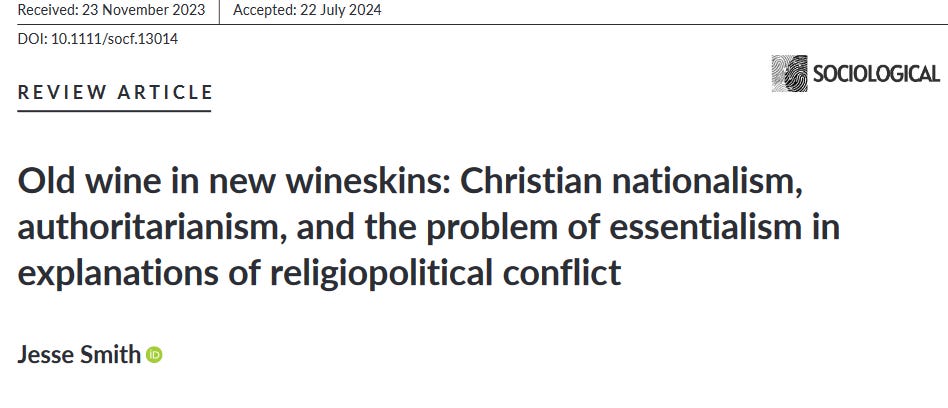
Smith shows that historical critiques of the study of authoritarianism hold true for the newer studies on Christian nationalism (hereafter, CN), that the study of CN is essentially the study of authoritarianism rebranded with all the same flaws.
Broadly, the study of authoritarianism and CN relies on and advances an essentialist model of political conflict whereby political ideologies, and conflicts between ideological groups, are driven by the essential, individual level differences (in personality, cognitive style, beliefs) of opposing group members. This is in contrast to the social models of ideology and conflict, which assert that ideological conflicts are driven more by contingencies, social dynamics, group allegiances, and material conditions, which play on the (largely) similar essential nature of human beings, regardless of which team one is a member of.
I believe there is some evidence for the essentialist model of ideological conflict—that liberals and conservatives, for example, do differ on some personality dimensions, on average. Much of the research supporting essentialist accounts of ideology, however, is tainted by the biases of the researchers, who are themselves motivated by the social dynamics of the ideological conflict in which we find ourselves.
As Smith says of the essentialist research on authoritarianism and CN: “researchers’ conclusions were driven by a priori assumptions, biased research procedures, and selective interpretation of evidence that “stacked the deck” in favour of finding support for their theory” of authoritarianism and CN.
He points out that the essentialist view of authoritarianism and CN “operates from an implicit assumption of religiopolitical conflict as driven by essential, individual-level pathologies, unevenly distributed across social groups in the population”.
It doesn’t take a genius to guess where the almost universally progressive-liberal researchers in social psychology locate these individual-level pathologies.
Authoritarianism
We’ll start with a short overview of the issues with the authoritarianism research.
Essentially, as studied by social psychologists starting with Adorno et al (a founding member of the Frankfurt School), the theory of authoritarianism basically asserts that authoritarianism can be thought of as an individual-level disposition or personality construct.
This construct is often said to be composed of sub-dimensions of various kinds, such as a dogmatic conventionalism (a rigid commitment to group norms and beliefs), authoritarian submission (a tendency to submit to group leaders and a desire to see others do the same), and authoritarian aggression (a desire to aggress against and punish norm violators and outgroup members).
Despite its essentialist nature, none of this would be overly problematic as a model of authoritarianism as a personality construct, except that from the very beginning the theory of authoritarianism was a politically-ideologically tainted one. The items used in the various scales of authoritarianism contained items that are conservatively coded. That is to say, the authoritarianism scales are tainted by items which conservatives (authoritarian or not) are more likely to respond highly to, thus they partially capture conservatism, not just authoritarianism.
For example, look at the first item of Altemeyer’s Right-Wing Authoritarianism (RWA) scale, which is used as the default scale for measuring authoritarianism (no bias there, right?). It asks respondents to rate their level of agreement with the statement: “The established authorities generally turn out to be right about things‚ while the radicals and protestors are usually just “loud mouths” showing off their ignorance.”
Arguably this item contains no actual authoritarian content. It merely asks who the respondent generally thinks is more correct about things—current popular society or radicals? It’s a non-normative question about how participants see the world. If one simply believes that radicals are… well, a bit too radical, then one would be scored higher in authoritarianism. This question might as well ask, “are you conservative or liberal?” and then score those who say “conservative” as authoritarian.
Even the RWA item asking about agreement with the statement “Gays and lesbians are just as healthy and moral as anybody else” doesn’t actually ask about authoritarian content—there is nothing about suppression or aggression against gays, merely a private value judgement (people who respond ‘authoritarian’ on this item might still be perfectly willing to accept legal equality, but still think gays are immoral, which is NOT authoritarian). This ensures that Christians and people who have a more conservative worldview will respond “higher” to the item than liberals, and therefore will be able to be slandered as authoritarian, which serves the researchers’ purpose.
Additionally, even the items which do capture authoritarian tendencies capture specifically right-wing authoritarians only (this is true even of supposedly politically neutral measures of authoritarianism, see Costello, 2023). Look at the item “Our country will be destroyed someday if we do not smash the perversions eating away at our moral fiber and traditional beliefs” from the RWA scale. You can fairly argue this is more relevant to authoritarianism, but still, it specifically captures conservative authoritarianism. A hardcore, authoritarian anarchist who endorses political violence and thinks conservatives and Christians should be exiled would respond with a low score on that item and thus be considered “not authoritarian”.
What results is a body of work showing that right-wingers are more authoritarian, and more dogmatic and rigid (using likewise politically tainted measures of dogmatism and rigidity), and who endorse political violence more (because the authoritarianism is likely related to endorsing political violence, and we have only measured right-wing authoritarians). As Costello et al say:
“the psychological processes underlying authoritarianism may be challenging to understand when only rightist authoritarians have been studied. As a point of comparison, consider the consequences of using exclusively male samples to develop the diagnostic criteria for a mental disorder. Presumably, this approach would overrepresent symptoms more often found in men and underrepresent those more often found in women. In turn, this bias might lead researchers to conclude that sex differences exist in said disorder (e.g., Yagoda, 2013). A similar process has plausibly occurred in political psychology—understanding authoritarianism’s manifestations in left- and right-wing populations may be a critical step in clarifying the nature of authoritarianism writ large.”
Is hunting wrong?

I’m a bit of a softy. I always have been. And I’m an animal lover, the kind of guy who smooches his cat way too much. As a kid, I would rescue the juvenile birds blown from their nests in spring, and for weeks I would hand-feed them jelly-meat cat food until they could fly. So, it’s no surprise that I have always struggled to process how I feel about my…
Conventional authoritarianism research in psychology pushed the idea that “right-wing political commitments or philosophies derive from individual-level pathologies that tend toward extremism and violence”, and that “Even when these “pre-fascist” tendencies do not come to fruition, they might still be detected in individuals through analysis of their attitude profiles” (from Smith, the target article linked above).
Thus, scales of right-wing authoritarianism were created, which don’t really ask about authoritarianism, but with people at the high end of the scale identified has authoritarian (their authoritarianism is often largely just inferred by the researcher), and the people at the very far low end as not authoritarian. As Smith states “it leaves respondents at the low end of statistical scales… undertheorized, despite evidence that these respondents might themselves exhibit intolerant or authoritarian tendencies under certain circumstances”.
Smith tells us that:
“the research approach taken by scholars of authoritarianism [is] akin to a hunting expedition—they theorize a type they set out to find, and are not interested in finding anything else. In effect, they follow a principle of “Maslow's Hammer,” interpreting whatever evidence they find as pointing to their pre-theorized type.
He notes, for instance, that when:
“Adorno et al.'s (1950) “High” research subjects expressed beliefs that did not fit with their theory, they simply dismiss those beliefs as “pseudo”—for example, pseudoconservatism, pseudodemocratism, pseudointellectuality—or simply a manifestation of denial.
Adorno et al. (1950) largely take the statements of Lows at face value or ignore indicators of pathology, while identifying authoritarian themes in statements by Highs that required substantial interpretation, if not projection, to discern.
[Much authoritarianism research is] designed to “catch” forms of authoritarian pathology likely to be found among cultural conservatives but not liberals.”
So, conservatives get painted as authoritarian, and liberals get painted is inherently not authoritarian, and the liberal social psychologists are happy, content that they have done rigorous, unbiased social science.
Christian Nationalists, the New Authoritarians
The point of Smith’s article is that essentially the same practices are going on in the CN research.
The article lays out a clear argument that, just like the authoritarianism research:
prominent scholarship ignores plausible alternative explanations and interpretive resources for their findings that would portray ostensibly Christian nationalist research subjects in a more benign light.
Second, it leaves respondents at the low end of statistical scales intended to measure Christian nationalism undertheorized, despite evidence that these respondents might themselves exhibit intolerant or authoritarian tendencies under certain circumstances.
All sorts of breathless claims are made about so-called Christian nationalists (citations for the quotes can be found in Smith’s article, linked above):
“Christian nationalism is many things, but above all, it is an effort to (re)assert the dominant moral and cultural authority of a white, native-born, straight, masculine, and Christian social order”…
it is “an ideology singularly oriented around contention for cultural dominance”…
“Christian nationalist ideology is fundamentally anti-egalitarian and anti-democratic”…
“Christian nationalism represents a fundamentally different religious dynamic than personal religious identity or religiosity that is ultimately related to broader social order and power”…
“The general principle [of white Christian nationalism] is this: white men must sometimes exercise righteous violence to defend (their) freedom and maintain social (and racial) order. It is freedom for ‘us’ and authoritarian social order for ‘them’”
These headline-grabbing findings echo the similar breathless claims made by authoritarianism researchers’ warning about the rise of right-wing authoritarianism. They are essentialist claims of underlying pathologies and beliefs that are actually “unmeasured” in key surveys, and “generally unarticulated by research subjects, but inferred by the researchers, and used as an interpretive guide for a larger pattern of statistical correlations.”
Just like the authoritarianism scales, a lot of the scales in the CN literature, like the Nationalist Pronatalism scale, the Christian Nationalism scale, and the Patriarchal Attitudes scale, contain items which only vaguely relate to the stated constructs and are very benignly worded, with the more extreme attitudes supposedly underlying these constructs “inferred” by the researcher. These scales have a significant amount of shared content, and are more likely to be endorsed by conservatives (because again, they basically just ask questions about things conservatives care more about), thereby inflating correlations between the scales and conservative or Christian participants, and allowing for all sorts of “interesting” and useful correlations, regressions, and mediations to be found, which can be used to support the histrionic claims quoted above.
Three great examples by Smith (emphasis added):
For instance, Baker et al. (2020) show that those with higher scores on a scale of Christian nationalism are more likely to question the epistemic authority of “science” while embracing beliefs linked to conservative Christianity such as creationism—a finding that on the surface appears unsurprising. From this, they conclude that “conflicts [over the epistemic authority of science] are less about science per se and more about status politics and attempting to assert social dominance”...
By this account, the content of the attitudes expressed by those high on the scale is incidental to the base motivation driving the correlations identified in the study, which at root is authoritarian. But this conclusion only holds if we accept the assumption that their scale of Christian nationalism is measuring fundamental orientations toward social dominance, a prospect that is unsupported based on an examination of their survey items (see Davis, 2023; Li & Froese, 2023; Smith & Adler, 2022 for relevant critiques).
A more parsimonious reading of the Christian nationalism measure leads to a more anodyne, even tautological, conclusion from their empirical results: people who desire a stronger role for religion in public life are more likely to favor religious sources of epistemic authority. This finding is easily explicable in terms of religious conservatism—that is, a greater propensity to rely on religious sources of authority—rather than Christian nationalism, which is argued to reflect a desire for ethno-cultural dominance per se.
And:
Elsewhere, Davis et al. (2024) show… that those higher on a Christian nationalism measure are more likely to prioritize rights such as religious freedom or bearing arms, over those of freedom of speech or the press and present this as evidence of the anti-democratic nature of Christian nationalism.
But importantly, their measures only capture which rights respondents view as the most important, a relative rather than an absolute judgment, and thus cannot be definitively interpreted as indicating a rejection of other rights. Responses may reflect research subjects' understandings of current political debates, in which they identify as most important those rights they believe to be the most immediately threatened.
Alternatively, respondents may view some specific rights as more fundamental than others to the larger project of securing rights in general. For instance, freedom of religion may be regarded as necessary for establishing an ideological or cultural foundation for liberal democracy (Gaston, 2019 ), or the right to bear arms may be understood as a check on the potential for government tyranny (Lund, 1987).
Many readers may find such rationales unconvincing or objectionable, but their merits are not relevant here. At issue is whether they characterize the views and motivations of those who profess them. By ignoring such alternatives without warrant, Davis et al. (2024) impose an interpretive lens of exclusionary, anti-democratic authoritarianism that amounts to an assertion rather than an empirical demonstration based on their findings.
And:
Perry, McElroy, et al. (2022) argue that Christian nationalism is a driver of “nationalist pronatalism.” They explicitly link this idea to mid-twentieth century fascist dictators, the manifesto of the perpetrator of the 2022 Buffalo, NY, massacre, and the oppressive regime portrayed in Margaret Atwood's work of dystopian fiction The Handmaid's Tale. More sympathetic, non-nationalistic rationales for pronatalism are minimized or ignored.
[They] show that their measure of Christian nationalism has a robust correlation with a purported measure of “nationalist pronatalism.” However, the four survey items they use to measure pronatalism make reference variously to “us as a nation,” “our society,” “our country,” and “our culture” (e.g., “It is a sign of how selfish our culture has become when couples choose to have fewer children”), treating as interchangeable vague terms that tell us nothing about respondents' views toward “nationalism” per se.
Since the nation-state operates as an implicit or default frame of reference (Miller, 1997 ), these views may only be “nationalist” in the same sense that virtually all survey items measuring social attitudes are “nationalist,” that is, in seeking respondents' views within the context of the particular society in which they live.
Furthermore, respondents were not asked about pronatalist views in any other context. Since a proponent of universalist pronatalism will logically also favor particular pronatalism—that is, someone who believes… that more children are desirable in general will by extension believe they are desirable in the United States—the available measures offer no leverage to distinguish between the mutually exclusive nationalist versus universalist pronatalism.
Thus, even based on such a brief overview of the issues, one can see that the much of the CN research, like the authoritarianism research, is ideologically motivated and biased.
It is based on a scholarly approach which is asymmetric and which “ensures that evidence of pathology will only be found among [certain] research subjects”, and which allow researchers to build entire bodies of work which make claims that while, “politically resonant, are sustained largely by a priori assumptions, asymmetric research procedures, and rhetorical effectiveness”.
Social science as witch hunts and propaganda
There is much more to Smith’s paper that I wont go over here, including a good summary of more balanced social models of extremism and ideological conflict as cycles of backlash and counter backlash, which don’t rely on unfounded claims of asymmetrical pathologies in particular ideological groups.
But the most interesting point, and the point of this article, is to show that, as Smith’s says:
“genuine theoretical progress is impeded by a social scientific milieu in which practitioners are relatively ideologically homogenous, share strong extrascientific normative commitments, address highly politicized subject matter, and are unlikely to empathize with research subjects.
To the extent that social scientists operate as partisan actors, the development and success of social scientific theories may be better explained by the dynamics of partisanship reviewed above than of science.
Effectively, social scientific claims themselves may take the form of propagandistic biases rather than empirically grounded statements about social reality.”
This is largely how research goes in social psychology. Bear this in mind when reading histrionic headlines based on social psych findings about misinformation, conspiracies, and the need for censorship. Or headlines about the rise of far-right Christian nationalism, or the ubiquitousness of white-supremacy. Very often these projects merely serve the “extrascientific”, propagandistic goals of partisan researchers.
The Left's belief in the "Invisible Hand" of Virtue

In his book, The Revolt of the Elites, Cristopher Lasch laments the invasion of free market principles into the realm of personal and civic virtue. Many readers will know and understand the economic theory of the invisible hand, a concept arising from liberal economics, which argues against the artificial regulation of markets and economies. It is posit…